Paddle Court Awards · specification guide
Age and skill divisions on pickleball inscriptions
Prepare pickleball inscriptions from the organizer's approved division schedule. Keep the event name, playing format, age label, skill label and placement in separate fields while the schedule is being reviewed. Then approve how those fields appear together on the award. This makes a change to one category visible without asking the designer to reconstruct the intended division from a shortened file name or a player list.
Reviewed 2026-09-05 · AI-assisted editorial review. General buying guidance; illustrative scenarios are not customer case studies. Images are AI-generated concepts.
Do not infer a recipient's competition division from their age, a rating on another website or the way another event grouped its players. The inscription should describe the recognition your event actually awarded. When brackets are combined or renamed, the director needs to confirm the wording that should appear on the physical piece.
Start with the event's controlled schedule
USA Pickleball's Tournament Director Guide includes choosing event formats and age or skill categories during planning. For the awards order, use the current approved schedule produced by that planning process. The supplier's role is to reproduce the accepted recognition wording, not to select the event's divisions.
Ask for a dated or numbered release of the schedule and identify the person who can approve changes. A registration export, promotional flyer and final bracket can contain different wording at different stages. Choose one authorized source for the production brief and record any deliberate departure from it. That prevents the proof reviewer from comparing the artwork to an older flyer while the coordinator is using a revised bracket.
Give each award category a stable internal reference. The reference can stay the same while a display label is corrected, allowing the proof and quantity change to be traced. Keep the internal reference out of the engraved text unless it is intentionally part of the design.


Keep the five content decisions separate
Treat the event name as the identity of the tournament, the format as the playing category, the age and skill labels as the approved division description, and the placement as the recognition being presented. These are related fields, but they answer different questions. A combined string is convenient for a short preview; separate fields are easier to correct and reconcile while the event plan is still changing.
Preserve the exact punctuation and notation approved by the organizer. A plus sign, decimal or range can be meaningful within a division label. Do not round, remove or restyle it merely because a spreadsheet or a graphic layout treats it as a number. If an abbreviation is desired, create an approved display version rather than allowing several people to invent their own short forms.
Keep the recipient name separate from the division fields. Two partners may receive identical category wording with different personal names. A shared trophy may show both names beneath one division description. The schedule should make that relationship clear without duplicating or changing the category label for each partner.
Choose a reading order that fits the recognition
Decide what the recipient should read first. An individual keepsake may emphasize the player's name, followed by the event and division. A shared club display may lead with the event or championship title. The organizer can choose either hierarchy, but the proof should preserve all information designated essential rather than allowing decorative prominence to decide what is omitted.
Try the complete inscription at the intended size. A line that combines format, age, skill and placement may need to be divided into shorter lines or arranged on a different inscription surface. The character checker can identify a line that exceeds a budget you enter. It cannot determine the actual font size, rendering or readable layout on the proposed product.
Review the longest approved combination early. If one category name is substantially longer than the others, it may need its own layout variant. The goal is a coordinated collection with legible inscriptions, not necessarily identical line breaks on every award. Keep any exception visible in the proof schedule so it is reviewed deliberately.
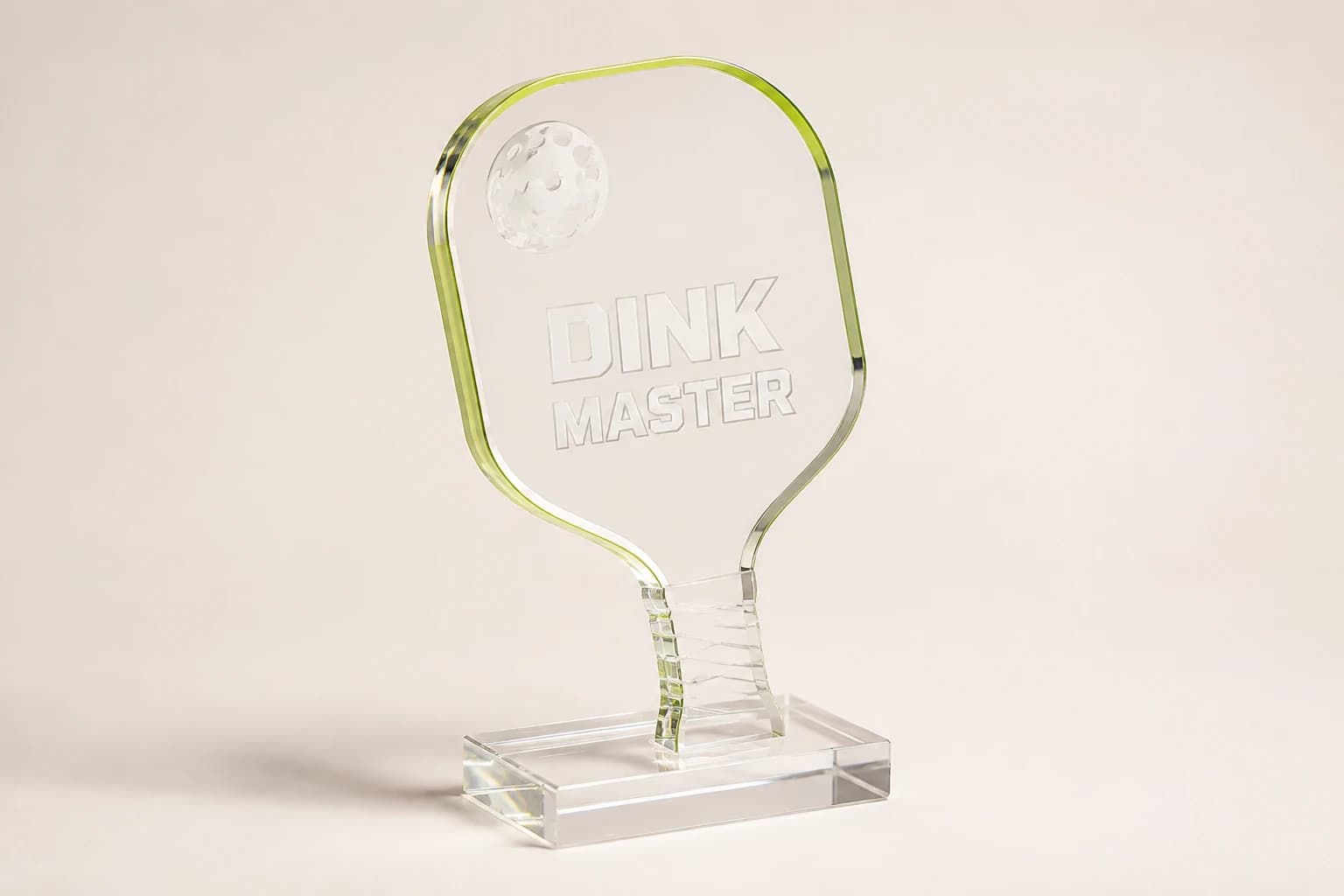
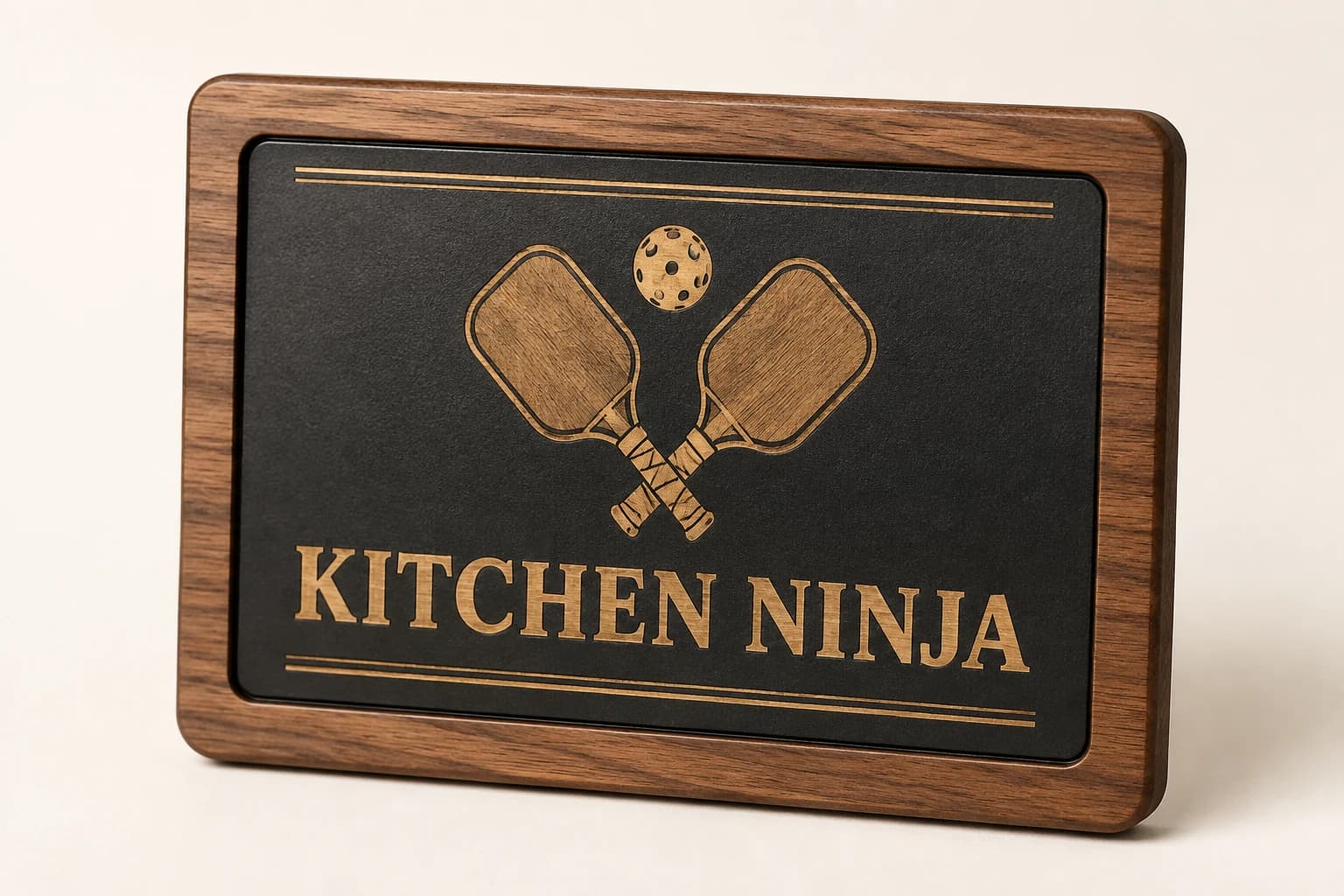
Illustrative wording: one division, several physical pieces
Consider a hypothetical event labeled Example Open. Its organizer approves the display fields Mixed Doubles, 50+, 3.5 and Gold, with the year 2026. One possible line arrangement is Example Open on the first line, Mixed Doubles on the second, 50+ | 3.5 on the third and Gold | 2026 on the fourth. These labels are invented for the layout example; they do not define an eligible division or a required tournament format.
If two partners each receive a personal award, those four shared lines can appear on two pieces, with each recipient's approved name added in the chosen position. The category wording exists once as a reviewed template but produces two physical awards. If a shared team trophy is also requested as a separate object, that creates a third piece with its own approved recipient treatment.
The downloadable schedule separates the category fields from the physical-copy count. Replace every sample entry with the event's actual approved wording before use. Do not import the example into an order as a real competition category. Its purpose is to show the difference between a reusable wording template, a personalization record and the number of physical pieces.
Try the division wording as separate lines
Load a hypothetical division inscription. Replace it with the exact labels approved for your event; the sample age and skill labels are not competition rules.
Method: Counts the entered text and compares each line with the user's chosen character budget. It does not validate division eligibility, tournament results, translation or physical engraving fit.
Build your plan
Counts include spaces and punctuation. Character count cannot establish physical fit: font, script, layout, material and engraving area require a proof at actual size.
Use the article’s example files
Download the illustrative working file and replace its sample entries with your approved project information. Review the article’s instructions before importing or releasing it for production.
Resolve merged or renamed brackets before release
When the event combines brackets, ask the director which division identity should appear on the award and whether the recognition remains split into any original categories. A merged playing schedule does not give the designer enough information to decide the intended inscription. Write the approved result in the release file rather than leaving both old and new labels side by side without instructions.
Identify every affected award reference. A category change may require an update to both partners' pieces, the shared display, the presentation list and the packing label. The physical quantity might remain unchanged while the wording changes across several objects. A quantity-only amendment would miss that work.
If production has already begun, send a specific change request tied to the current order version. Ask what can still be revised and what effect it has on the proposal. Editing an internal spreadsheet does not notify the production team or establish that completed personalization can be changed.
Choose the correct source for each field
These sources have different jobs. Keep the final engraving authority clear when their wording differs.
| Option | Use in the awards workflow | What to confirm |
|---|---|---|
| Approved division schedule | Source for the event's accepted format, age and skill labels. | The release version and the person authorized to approve a change. |
| Final recognized result | Source for the placement and any result-dependent recipient assignment. | That the director has confirmed it for the award being produced. |
| Recipient display-name record | Source for the exact personal name or shared-team name. | Spelling, punctuation and whether both partners should be named on each piece. |
| Actual-size proof | Shows the approved fields arranged on the selected design. | Every essential field remains present and each line belongs to the correct category. |
| Packing and presentation list | Connects physical pieces to the receiving and ceremony sequence. | Internal handling notes are kept outside the engraving fields. |
Approve translated labels as complete phrases
For a bilingual event, identify who approves each language's division wording. Give the reviewer the full category and the intended meaning rather than translating isolated fragments independently. A short form used in one language may not have an equally clear short form in another. Keep the accepted versions attached to the same category reference.
If both languages appear on one award, state that arrangement explicitly and review the actual-size layout. Two language blocks do not automatically create two physical pieces. If separate language versions are being supplied, count them as separate objects and identify the recipient for each. The physical order should follow the chosen presentation plan rather than the number of translation columns in the file.
Check category consistency across the pair and the event
Review each proof against its category reference, not only against the neighboring award. A repeated spelling error can look consistent across a whole order. Confirm the event identity, format, age and skill notation, placement and year independently, then check that the two partners' pieces carry the intended shared wording.
Separate a design change from a content change in the review notes. Moving the placement to another line can be a layout decision; replacing its wording is a content decision. When both happen together, record both. This helps the final approver understand what changed between versions and avoids approving a visual correction while overlooking altered recognition text.
Retain the final category dictionary for the next event
Archive the final approved category labels with the event year, proof references and physical quantities. Record any observed confusion in the presentation or packing process against the relevant category reference. Those notes can help the next coordinator prepare a clearer schedule without recreating the entire workflow from scattered messages.
For a later event, start a new release and reconfirm its divisions. Reusing the visual style is different from reusing the old competition structure. Keep last year's labels as reference material, not as automatic instructions for new awards. That preserves the useful design work while giving the current event owner control of its recognition wording.
Division-inscription questions
Should I engrave the player's current rating?
Use the division wording approved for the recognition, not a rating inferred from another record. If the organizer specifically wants a rating included, obtain the exact approved text and its intended meaning before preparing the proof.
Can I abbreviate a long age or skill category?
Yes, if the event's wording approver accepts the display version. Keep the full source label and the approved abbreviation connected in the schedule so different awards do not receive improvised short forms.
What happens when two brackets merge?
Ask the director to confirm the award wording and identify every affected piece. A merged playing schedule does not by itself tell the supplier which original or combined category should appear on the inscription.
Does the text checker confirm the inscription will fit?
No. It counts the text against a line budget you choose. The actual-size proof must establish the arrangement on the proposed inscription surface, including the selected font and any language-specific review.
Explore the collection’s design direction
This existing narrated collection overview introduces the product designs. It provides visual background; the specific decision, comparison and worked example are in the article above. Images are original concepts rather than completed customer orders.
25-second overview
Count pickleball doubles and division awards accurately
Start with the divisions your pickleball event will run. Count each awarded placement and decide whether both doubles partners receive a piece. Keep partner names separate from division labels. Review long names, plan for late results and add volunteer awards as their own group. Reconcile the final quantity before sending the artwork and brief.
Prepare your brief and request a written quote.
Bring this decision into your design brief
Choose a relevant product direction and include the measurements, quantity, approved wording and delivery destination for your project. We can then develop a specific design and quote around those requirements.
Sources and scope
The sources below support the cited technical details. The ordering workflows are editorial recommendations. Your project specification, price and schedule are established in the written quote and approved proof.
- USA Pickleball: Tournament Director Guide · checked 2026-09-05
Which buying guide should you read next?
All buying guidesBuild an award matrix by event, division and placement, then multiply by the number of players receiving a piece. Decide explicitly whether both doubles partners receive awards. Keep division labels, partner names and event wording in separate fields so the total quantity and the personalization remain consistent.
Choose a trophy, medal or combined award plan around what each partner takes home, how the ceremony works and the actual packed proposal. Compare the same recipient count and included personalization.
Calculate the incremental pieces for an additional recognized bronze team without changing tournament rules, doubling all divisions, or treating generic spare awards as personalized replacements.
Count awards from the divisions and placements you will recognize, including both players when doubles partners each receive a piece. Separate player awards from shared trophies, then group the order by presentation session and receiving destination. Keep winner names distinct from division labels.